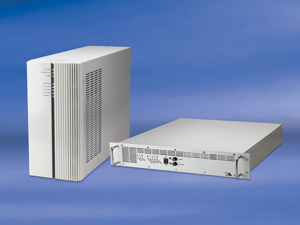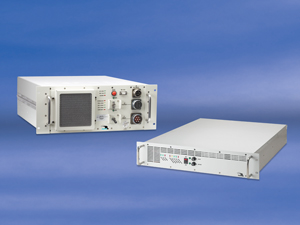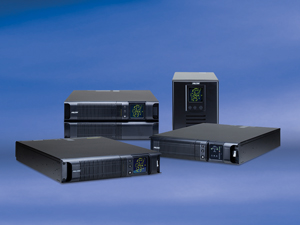
Voltage and Frequency Converters
 |
Frankfort Electrical Services
"The Falcon SG 6kVA Frequency Converter was able to quickly solve my customer's challenge of powering a sophisticated 50Hz European vacuum centrifuge analyzer."
Jerry Frantz, Owner |
 |
Edwards AFB
"Other frequency converters were larger, heavier and more expensive than the Falcon UPS."
Charles Vatcher, Mechanical Engineer, 412 Test Wing / Test & Eval. |
Tell us about your application requirements
An alternating current (AC) occurs when charge carriers in a conductor reverse their direction of movement over a period of time. Household utility current in the United States and most other countries in the Americas is AC with a frequency of 60 Hertz (60 complete cycles per second). On the European continent and in many other countries, the utility is generated at 50 Hertz (Hz). Some military and aircraft applications generate 400Hz power and are rarely found outside of their respective areas. For more information on our 400Hz frequency converter solutions, refer to our Military and Aerospace Section. All AC frequencies are generated in a sine waveform. The example below shows a typical AC sine wave.
Alternating Current and Frequency Conversion
Alternating current is generated in various voltages. In the U.S., the most common voltage found at the typical household outlet is 120 Volts AC (Vac) at 60Hz. 208Vac and 240Vac at 60Hz for commercial applications are also found. In Europe, the most common voltage is 230Vac at 50Hz; other 50Hz voltages are also found. The total solution for both voltage and frequency conversion is a dedicated voltage and frequency converter. In contrast, an independent solid state frequency converter or international voltage converters will solve only one element.
International Voltage Converters
Typically, most U.S. equipment has been designed to operate on 120Vac, 60Hz and will not operate from a European utility source without a voltage converter. International voltage converters, whether a solid state frequency converter or not, usually consist of a simple transformer that steps the utility voltage down or up to match the equipment’s requirements.
This transformer type voltage
converter does not convert the AC frequency. Some equipment must
operate at the AC frequency for it was designed to prevent equipment
damage. Care must be taken to properly research the requirements
for any equipment or device that is to be operated on a differing
utility frequency. The specified input voltage and frequency
is usually stated on a label located somewhere on the equipment.
When planning to operate the equipment on an alternate utility
frequency, refer to the owner’s manual or contact the equipment
manufacturer to verify compatibility with the differing utility
frequency.
Frequency
conversion is more difficult and costly to accomplish than
simple voltage conversion. An entirely new AC sinewave of
the correct frequency must be regenerated from the incoming utility
power. Falcon Electric’s On-line products, such as the
SG, SVR or ED models have been specifically designed to meet
this demanding application. Falcon also offers selected models
that provide both voltage and frequency conversion in the same
unit. Many models also provide battery backup and can be configured
with optional extended battery banks, which yield hours of backup
time.
Much
More Than a Voltage & Frequency Converter
Falcon
Electric’s On-line voltage and frequency converters
deliver superior output voltage regulation (±2% typical).
They also provide a high level of protection against a broad
spectrum of power problems, such as transients, surges, brownouts,
high line conditions and noise. Some models have internal galvanic
isolation, which is the best solution for eliminating common
mode noise and ground loop problems. SG and SVR models are equipped
with input power factor correction that reduces input current
and harmonics.
Don’t
be confused. Other off-line and line-interactive Standby
Backup Supply (SBS) products on the market pass the incoming
utility AC directly through to their output and cannot be used
as frequency converters.
© Click
here to go to our Quick Selection Guide to find the International
Voltage and Frequency Converter that is right
for your application.
©1999-2013
Falcon® Electric, Inc. All rights reserved throughout the world. Falcon and the Falcon
Electric logo are registered trademarks of Falcon Electric, Inc. All other brand
names and trademarks are the property of their respective owners. The information
and specifications stated on this website are subject to change without notice.
Legal & Private Policy | Contact Us
|